
Daniel Ortega Says Nicaragua Will End National Elections
By: WNEWS247 Editorial Staff
Published: July 23, 2026
MANAGUA, Nicaragua — Nicaraguan President Daniel Ortega said his government will no longer hold national elections, marking a major shift in the country’s political system and prompting criticism from the United Nations over the future of political participation and human rights.
Ortega made the announcement during a rally in Managua on July 19 celebrating the 47th anniversary of the Sandinista Revolution. Speaking before supporters, the 80-year-old leader said Nicaragua’s National Assembly would pass laws to prevent what he described as foreign-backed political forces from returning to power.
“We are not going to waste time holding elections,” Ortega said, arguing that previous governments supported by outside powers had harmed the country. He said new legislation would create what he called “a wall” against parties that he accused of serving foreign interests. The proposal would end regular national elections, which have been the formal process for choosing the country’s leadership for decades.
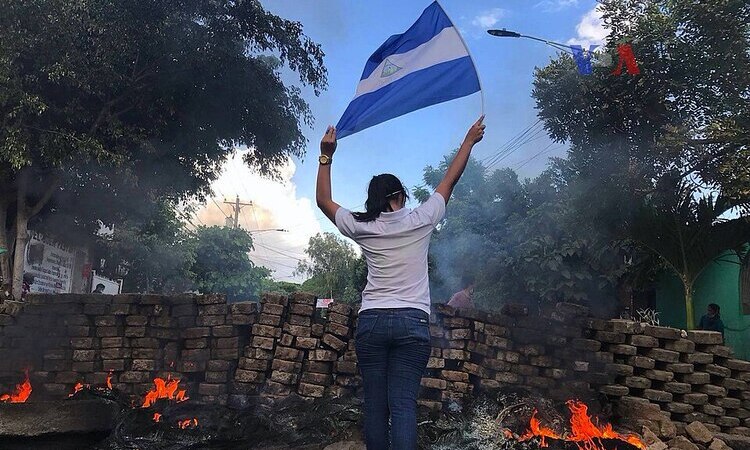
A woman waves Nicaragua’s flag near a burning barricade during 2018 anti-government protests that left more than 300 dead — a crackdown that set the stage for Ortega’s 2026 announcement ending elections. (Photo: Voice of America / Public Domain).
Years of Expanding Executive Power
Ortega has governed Nicaragua continuously since returning to office in 2007 after previously leading the country during the 1980s.
In January 2025, Nicaragua approved constitutional reforms that extended presidential terms from five years to six and formally named Ortega’s wife, Rosario Murillo, as co-president. The changes also postponed the next general election from 2026 to November 2027.
Ortega’s latest announcement suggests that election will no longer take place.
His Sandinista National Liberation Front already controls the National Assembly, while critics say opposition parties, independent media, and civil society organizations have faced increasing restrictions in recent years.
The 2021 presidential election drew international criticism after several potential opposition candidates were arrested before voting took place. Nicaragua’s government rejected those criticisms, saying it was enforcing national laws and protecting the country’s sovereignty.
United Nations Raises Human Rights Concerns
UN High Commissioner for Human Rights Volker Türk said Ortega’s announcement represented another step in reducing political participation in Nicaragua.
In a statement released July 22, Türk said the country’s electoral authorities, courts, legislature, and security institutions have become increasingly concentrated under the presidency. He urged the government to ensure that Nicaraguans can freely express political views and participate in public affairs, including voting and running for office, in line with international human rights obligations.
The UN rights office also raised concerns about the continued detention of dozens of people on political grounds and questioned recent actions against lawyers and members of the Catholic Church.
According to previous UN investigations, more than 300 people were killed during the government’s crackdown on nationwide protests in 2018. Since then, international human rights organizations have repeatedly reported tighter controls on political opposition, media outlets, and nongovernmental organizations.
International Attention
Ortega has increasingly strengthened diplomatic and economic ties with China and Russia in recent years, while relations with the United States and several European countries have deteriorated following the disputed 2021 election and subsequent sanctions imposed on Nicaraguan officials.
At the time of the announcement, Ortega had not provided details on when legislation ending elections would be introduced or how the proposed changes would be implemented under Nicaraguan law.
The announcement has drawn international attention because regular elections are widely regarded as a central feature of representative government. Human rights organizations and the United Nations say the ability to vote, compete for public office, and participate in political life is protected under international human rights agreements to which many countries, including Nicaragua, are parties.